Cheese tray, red wine and a good book …
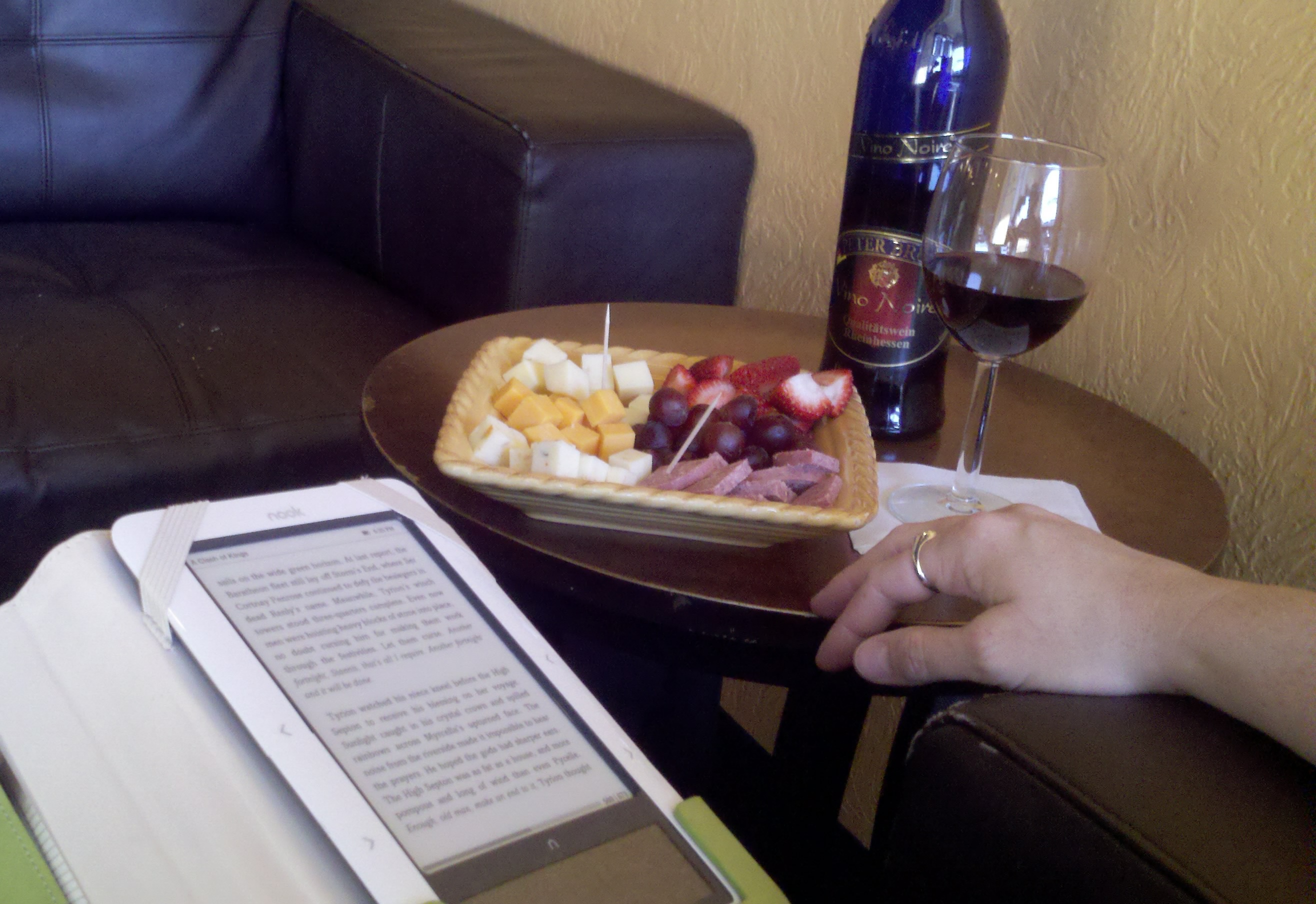
… the trifecta for a perfect evening to myself.
Cheese tray, red wine and a good book …
… the trifecta for a perfect evening to myself.
Sometimes, our fellow passengers are the ones who are afraid. Pray today for someone in your life who needs courage.
I am not reading anything new right now, whether for school or pleasure. I am on p. 492 out of 873 in A Clash of Kings, which is difficult to put down to concentrate on my required reading concerning education policy, but I’m managing my time ok right now. Things at work have been pretty busy lately, so I thought I would talk this week about writing grants. Grantwriting (yes, I prefer it as one word, though I’ve seen it both ways … I think either is acceptable) can be intimidating. Then again, asking for money face-to-face is intimidating, too!
I have worked with grants in some way, shape or fashion for about 12 years. I’ve experienced the process from start to finish: researching prospective funders, writing the proposal, editing and submitting the proposal, stewarding the funder and administering the budget. My favorite part of the whole process is writing the proposal. It may sound like a no-brainer, but the key to success in grantwriting is to follow directions. If the funder says to use Times New Roman 12pt font with 1″ margins and no more than three pages, then by golly, don’t ramble on for five pages in Arial, for cryin’ out loud.
Before you start writing, research what the foundation/agency has funded in the past. If they don’t have a website, look up their IRS Form 990 — they have to report earnings and distributions. It isn’t always necessary to apply for the same thing as another organization, but you do need to be mindful of the funder’s interests and priorities. If they have a website, be sure to look at the president’s bio or welcome page. There are often nuggets of very helpful information about the funder’s strategic plan or vision.
When I first began writing grants, it reminded me a lot of scholarship applications that I submitted my senior year of high school. There are standard tidbits of info that you ought to include about yourself, yet you want to make yourself stand out, so you pick a couple of accomplishments or interests that might make your application resonate with the reader. The same goes for grants–you must be keenly aware of their funding priorities, yet you need to paint a word picture of how your project/program is different from the [many, many] others that they will read.
No matter what the result of the proposal, send an acknowledgement letter. In my office, we refer to the “Thank you for rejecting us letter” that we send when a proposal has been declined. We thank the foundation for considering our request, acknowledge that we realize not all requests can be funded, and end with a positive sentence about how we look forward to finding future opportunities of mutual interest. It never hurts to be gracious, even when you’ve been rejected. It might just be that same program officer who reads your next proposal and is more willing to give it a second chance.
Life can feel like waiting in line, wondering what God has in store. His plans are worth waiting for; meanwhile, be faithful in prayer.
When I think of impoverished areas of Texas, the first places that come to mind are the inner cities of Houston, Dallas, San Antonio and El Paso, followed by rural communities and the Rio Grande Valley. Ironically, with 22.8% of residents living below the poverty line (according to the 2009 census), my county that is tucked away in the heart of Central Texas is worse off than the state average of 17.1%. We rank 209 out of 255 counties.
All that is to say, there are big needs right here in our own backyard. Last night, our church missions team held a training meeting for folks who signed up to help with summer camp at our government housing ministry. We’ve had a presence in that community for about three years, and this is the second summer that we are hosting a day camp, of sorts. It happens twice a week in the early evening with indoor & outdoor games, arts & crafts and dinner.
The kids & I have been involved in the ministry through tutoring during the school year and other activities in previous summers, but I still learned a lot at the training. For example, we talked about how it is more useful to redirect a child than to give them negative instructions. (How many times a day do I catch myself telling my own boys to “stop,” “don’t,” “quit,” etc.? I am going to work on some redirecting phrases, such as, “Instead of climbing on the basketball goal, why don’t you climb that tree?” in place of, “Get off that basketball goal right this minute! You know better than that!”
Another thing that really hit home to me was a quiz on how well you could survive in poverty, middle class and wealth. The poverty section tested your street smarts. The middle class section had questions about etiquette and family priorities. The wealth quiz asked about your domestic help, private school and vacation homes.
Not unexpectedly, I was able to check all of the middle class questions. I also answered a handful of questions in the poverty and wealth sections (an equal number apiece). I have picked up a few nuggets of knowledge about the wealthy, simply from my job. Fundraising lends itself to hobnobbing with the upper crust, though I usually feel more like the chauffeur from Sabrina than an actual participant.
It was humbling to take the quiz and be reminded of how truly blessed I am. If you think about it, I’d appreciate your prayers for our ministry at the “blue house” (that’s what the kids call it) as we try to make a few drops in the bucket of generational poverty in our community.
Sunday’s devotional referred to God as the Great Engineer. Is it hard to believe that he has a plan for your life? Will you trust him today?
Something bit or stung me while I was pulling weeds from the bushes in the yard last week. It doesn’t itch as badly as it did the first few days, and the swelling has gone down, though it doesn’t seem to be completely back to normal. One friend suggested that it might have been a wolf spider, because of the two puncture marks. 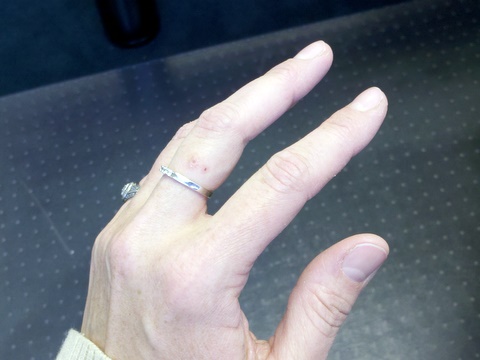
That idea creeps me out (and so did the images that popped up when I Googled the critter!), but from what I understand, wolf spiders are bug-eaters, so they can’t be all bad … except if/when they nibble my fingers!!
*Note to self: Wear gardening gloves at all times!
My life is an open book, in many ways. I try to be relatively transparent because I realize that it’s part of my ministry to let people see me be human. I’m not perfect. I’m not Super Mom. But, if someone finds encouragement through my frustrations, through the goofy stories that I tell about my boys, and even through the grief that I’ve exposed over the past few years, then I feel like it’s worth sharing.
What about the times when I don’t want to share? I’ve been thinking a lot lately about public figures (not that I am one, by any means, but I think there are similar struggles in our efforts to balance openness and privacy). Does the elected official have any hope of hiding her child’s mug shot from news reporters? Does the Hollywood star have any chance of downplaying his crumbling marriage? Does the professional athlete really think that no one will find out about his drug use? These are the makings of the evening news, sure, but what about issues on a smaller scale … between “little” people like us?
Sometimes, my heart is heavy and I write about it. Other times, my heart is heavy and you may never know. Therein lies the challenge: transparency vs. opacity.
In a world of news at your fingers,
Privacy is just a setting:
How much do you share with whom?
Transparency crowds out
Personal space and
Opacity
All that’s left
Is just
News
What are you afraid of? Heights? Death? Whatever your fear is, turn it over to God and ask him to conquer it. He is able!
Do you have a favorite thrill ride? What makes you keep going back? Ask God today to put that same excitement in your heart for him.
 faith, sweat & tears