The Gift of Presence (Prayer Devotional for the week of January 20, 2013)

Twenty-four years ago this month, my maternal grandmother went to bed one night and woke up in Glory. My mom has some very old voice recordings from her – verbal letters that my grandmother mailed to us when we lived overseas more than 35 years ago. It is truly a gift to be able to hear her voice again, after all this time.

In John 13 and a few chapters following, the Bible tells us about some of the final hours that Jesus spent with his disciples before his betrayal and ultimate crucifixion. They shared a meal together, and he washed their feet like a servant would do. He comforted them about what was about to happen. Although they did not quite understand it, at the time, he was trying to prepare them to cope in his absence. He gave them the gift of his presence.

Jesus’ resurrection and later ascension into Heaven are certainly two of the biggest highlights of the Bible, but I wonder if the disciples went through another form of grief after Christ left them a second time. They knew, of course, that he was not dead this time – he was taking his rightful place with the Father, but he was still gone.

Jesus didn’t leave them empty-handed, though. John 14 tells of his plans to leave them the Holy Spirit. Various translations refer to the Holy Spirit as a Comforter, Advocate, Helper or Friend. Jesus told his disciples that the Holy Spirit would teach and empower them. He would not be with them in person much longer, but he would leave them the ongoing gift of his presence.

Unlike a voice recording, or even a video tape, which can only remind us of a departed loved one, the Holy Spirit is living and active! Jesus has not walked the Earth in nearly two millennia, but his message spreads and thrives because of the work of the Holy Spirit living in us and working through us.

So, if the Holy Spirit is Christ’s gift to us, and that Spirit lives and works in us, does the world sense his presence in us?

The Year of the Lord’s Favor (Prayer Devotional for the week of December 30, 2012)

Sitting by the fireplace the other evening, I watched the last flame flicker out and thought about the year coming to a close. As the fire died and a small chunk of log smoldered red in the grate, Gungor’s song, “Beautiful Things” came to my mind. In case you aren’t familiar, it’s about God taking the windswept, chaotic trials of our lives and turning them into wondrous, new things that bring him glory. God sweeps up the dust – the ashes, if you will – the burned up remnants of pain and suffering that we would like nothing more than to forget about and toss out, and then he creates something beautiful and enduring out of it.

I think this song has been on my mind partly because, to be completely honest, the holidays are difficult for me. I ache with grief that feels almost like a physical pain. I mask it pretty well between Thanksgiving and Christmas by focusing on the nativity story and enjoying the kids’ wonderment, but then New Year rolls around. As each New Year approaches, I want to join in the festivities but it’s difficult to feel like celebrating when my heart hurts, and January 1st just serves as a harsh reminder that another year has flown by without my brother.

And yet, God can take my sorrow and transform it into peace, and even joy. I know this because I’ve experienced it time and time again, and best of all: I know that my mourning is not forever.

In Isaiah 61, the prophet describes for the Israelites what things will look like in The Year of the Lord’s Favor. In addition to much-anticipated remedies like rebuilding their city and releasing captives from their enemies, Isaiah talks about wearing “a crown of beauty instead of ashes, the oil of joy instead of mourning, and a garment of praise instead of a spirit of despair” (v. 3, NIV). God is going to take heartache and turn it into delight!

If you are looking forward to the New Year with happy spirits and your chin held high, then marvelous for you! I encourage you to focus on making 2013 your personal Year of the Lord’s Favor by putting him first and foremost in your life and rejoicing in your blessings. If, on the other hand, you are feeling more like I described earlier and the New Year doesn’t seem particularly celebratory, then I hope you will find encouragement in knowing that whatever trials you are going through, the pain will not last forever. The heartache may ebb and flow, but know this: God has already written the last chapter, and he is our Victory over sin and death. Now that is something worth celebrating!

Extra goodnight hugs

I wrote my last post early this morning. When I came back from lunch and heard about the tragedy in Connecticut, I realized how ominous it must have sounded. It’s just something that has been on my heart for a long while: what my purpose is and what life means when it is seemingly cut short. I always wax sentimental at this time of year, as I try to steel my nerves for the grief cloud that is sure to hover over me in late-January near the anniversary of my brother’s death.

I haven’t turned on the television or looked at Twitter since I got home from work, because I’m trying to insulate my heart from a nonstop stream of details about today’s school shooting. We spent the evening after dinner addressing 24 teacher gifts. I was planning to do it later this weekend, but today seemed fitting to pause and thank them for all that they do, each and every day. I want to hug the kids tightly and promise to protect them always, but I know that is a promise that I cannot keep. At some point, I have to release them into the Lord’s care and just … trust. It’s a terrifying notion to be reminded that I am incapable of keeping them safe 24/7.

So, I will hug them a little snugger and kiss their foreheads a little bit longer and offer a prayer of thanksgiving for another day … together.

Purposeful life

I’ve questioned the notion before that life will work out hunky-dory, if only we love God and behave ourselves, because, at the risk of sounding like a pessimist, I just don’t believe that we are guaranteed happy endings. For as long as I can remember, well-meaning religious people have been quoting Romans 8:28: “And we know that in all things God works for the good of those who love him, who have been called according to his purpose” (NIV).

What they leave out, however, is the next verse, which talks about being “… conformed to the image of his Son,” namely, Jesus. The chapter goes on to say that nothing can ever separate us from God’s love, and that is true, but it doesn’t mean things will be easy-breezy.

I realize that Jesus (and his uncannily blonde mother, Mary, for that matter), look like well-groomed models who just stepped out of a Pantene commercial in the paintings, but Jesus led a hard life. Besides the fact that such everyday luxuries as motor vehicles, air conditioning and Crocs had not yet been invented, Jesus was not wealthy by any stretch, and he was insulted, ignored, betrayed and ultimately killed. He apparently lost his earthly dad sometime in his teens or 20s. His own neighbors rejected his message.

We all have many, many blessings for which to be thankful.  I have experienced exquisite joy in life; please don’t get me wrong and think that I’m raining on the religion parade. What I’m trying to say is that I don’t think our lives are just about us. I don’t think that life is just about my accomplishments and dreams and the legacy that I leave behind. What about people who die without a so-called legacy? What about the young mother who dies of cancer, or the stillborn baby or the elder who lives alone? I’ve just been struggling with the idea that sometimes, life’s purpose may be larger than us. Our lives are part of a bigger picture, and not necessarily portraits, in and of themselves.

Consider Job’s first batch of children: he had seven sons and three daughters. In a freak windstorm, all 10 of them were crushed to death in a house collapse. That tragedy was just one of a litany of calamities that happened to Job. If you read the whole story, you learn that God restored his family and gave him 10 more children later in life. (Which, by the way, makes me think that perhaps giving birth to 20 children was part of his wife’s punishment for telling Job to curse God and die (Job 2:9-10), but I digress.)

Were the lives of Job’s first 10 children pointless? For lack of a better term, they really just seem like pawns in the overall strategy. That’s a tough pill to swallow, to think that my life might simply be a lesson illustration. I want to accomplish great feats in life, but what I’ve been learning in recent years, as trials and detours keep chipping away at my pride, is that I need to be content with whatever God has in store for me. Sometimes, my goals don’t pan out the way I expect them do, but that doesn’t mean that I should hang it all up and quit trying. I will keep striving, pursuing and reaching toward my dreams, and I will thank God for letting me play a role, however significant – or not – in his story.

Watching the fire

It has been a long, draining, challenging day, and we’re expecting another overnight low around the freezing mark, so I decided to light a fire and kick back with a glass of my favorite Pinot Noir by Peter Brum. I’ve been watching the fire, and my brain is swarming with thoughts:

  • Wouldn’t it be cool if we could travel and talk to each other via floo powder, like in the Harry Potter series? I think of the time when Sirius appeared in the fireplace of the common room, which then reminds me of how he appeared again when Harry activated the Resurrection Stone. I have seen that movie at least a half-dozen times, and I cry at that scene every, single time.
  • Did I set my variables correctly in the columns and rows, or are they backwards? What the heck is the difference, and are they “within” or “between” comparisons? Did I choose the correct ANOVA measurement? Am I going to finish this paper in time? What will I do if I cannot disprove the null hypothesis? This paper is the groundwork for my dissertation, and I haven’t even entertained the thought of starting over with a new topic.
  • I think about the first camp bonfire that I can remember: roasting s’mores and singing while the camp leader played guitar.
  • I think about the house fire that I covered while working as a newspaper reporter: a family watching their house being gutted from the inside-out.
  • Life is like fire sometimes. Once it starts blazing, it’s too late to change your mind and decide you didn’t want to light it. You have to wait it out; let it burn. I hear the whoosh, pop, crackle and think about the things that feel like they are whooshing, popping and crackling in my own life. Sometimes circumstances feel out of control or undesired, but then I remember that the safety mesh that keeps the fire from tumbling onto the hearth (and into my den, setting my house ablaze) is like God’s hand in my life. Sometimes, it feels like he lets the fire rage, and when I’m in the middle of it, it can feel unbearable, but then I am reminded that he has everything under control; there is nothing to fear.
  • I wonder about my colleague who died. He wasn’t married and had no kids, but he still left behind a family. I think about dying sometimes. I hope that I’m an old woman when the Lord brings me home — though not miserably old, just contentedly so. If he were to take me sooner, then I trust that God would take care of the boys, not only for their physical well-being, but also emotionally. But still — I’m not in a hurry to leave. What’s ironic is that if I were to suddenly die, then I’m sure that somehow, someone could attribute it to my being overweight. And yet, look at my colleague, and my friend’s dad, and other seemingly healthy, active people who actually exercised on purpose. I tell ya, it isn’t very motivating. Yeah, yeah — I know I need to be more active and get back to being physically fit, but sheesh — if people are dying who actually like to work out, then what hope is there for the rest of us?! I’m just sayin’.
  • The fire is still burning out, and I don’t like to leave it unattended, so I can’t go to bed yet. Come to think of it, I don’t know exactly what I’d do if somehow it did escape the safety mesh. I suppose I’d go fetch the fire extinguisher and hope that it still worked after having not been used for however many years it has been stored under the kitchen sink. I should probably look into testing &/or replacing it.

Cobwebs

A young man I know from my old job died suddenly. We don’t know any details, and I don’t suppose it matters; people are just curious to know how and why these things happen. I always feel a twinge of sadness for the loved ones left behind when I hear about someone who died, but today feels different.

We weren’t close friends; I didn’t even know him outside of work. He has always reminded me of my brother, though, and I guess that’s why it’s tough. He was a tech geek and a fitness buff. He was kinda quiet but had a sarcastic sense of humor.

Much like Nathan.

News like this dusts off the cobwebby corners of grief in my heart all over again.

The what-ifs we don’t want to discuss

I’ve talked before about anticipatory grief and how sometimes my mind jumps straight to the what-if in a frightening situation. I also vented recently about the many folks I know who are fighting (or have fought) cancer. Since that post, the neighbor has died, and the friend has exhausted treatment options.

Personally, I think it’s a dangerous thing to say, “I could never handle [insert major life catastrophe here].” I’m not saying that we ought to invite calamity into our lives, but if we negate our ability to survive disastrous circumstances, then I believe we discount God by inadvertently saying that he’s not able to get us through whatever the what-if scenario is. Consider the book of Job in the Bible. He lost everything that we hold dear — his wealth, his health and even his children. He was targeted because he was strong in his faith, not because he was a rebel who made a spectacle of himself and had to lie in the bed he made.

I also advise against saying things like, “If I were in their shoes, I would [insert definitive statement about how you would handle their problem].” How do we really know how we would respond until/if we are faced with that situation? I don’t personally believe that suicide or euthanasia is ever the answer, and yet I think of elderly or injured people who are sustained by feeding tubes. When we turn off that level of support, aren’t we letting them die? Isn’t that what many people want — to not be kept alive by machines? Where is the line? How do we decide where to draw it?

What do we say to the person who is out of treatment options for cancer? What about the person who quits treatment that doesn’t show promise? What about the one who chooses not to pursue treatment at all, but lets the disease run its course for however long it takes?

How do we know when it’s ok to let go and say goodbye?

I was thinking about Elijah today, because he had to figure out the answer to that question. 2 Kings 2 tells about his mysterious disappearance/rapture into heaven. Somehow, God had revealed to him that he was about to leave, so his apprentice Elisha stayed on his heels the whole day, not wanting to miss a moment. I wonder who else he may have left behind. I am not a Bible scholar, but I imagine he probably wasn’t married, given the nature of his role as a prophet. However, I wonder if he had parents or siblings.

We think it’s so awesome (and don’t get me wrong – it is!) that Elijah was delivered to heaven in such an amazing fashion, and yet there were those (like Elisha) who were left to grieve his loss. Elisha knew it was coming, and he was better prepared for the farewell. Others thought that Elijah might reappear somewhere else, but Elisha knew that he was gone.

God’s miracles occur in bizarre ways, sometimes. They may not always result in physical healing, and that’s a difficult thing for me to wrap my head around, especially when prayers have been offered in faith. Sometimes, I think, God moves like he did for Elijah and escorts people home, rather than leaving them to roam the Earth.

The ones left to pick up their cloaks, figuratively speaking, have to try to figure out what the new “normal” is supposed to look like without them.

My peaceful porch

One of these days, I would like to build (or have someone build) a bench attached to the freshly-painted railing (I would finally be motivated to do it!) on my front porch. I envision putting a couple of all-weather cushions on it and sitting out there sipping a beverage or reading a novel and watching the boys play in the front yard. In the meantime, I have a couple of patio chairs that will suffice.

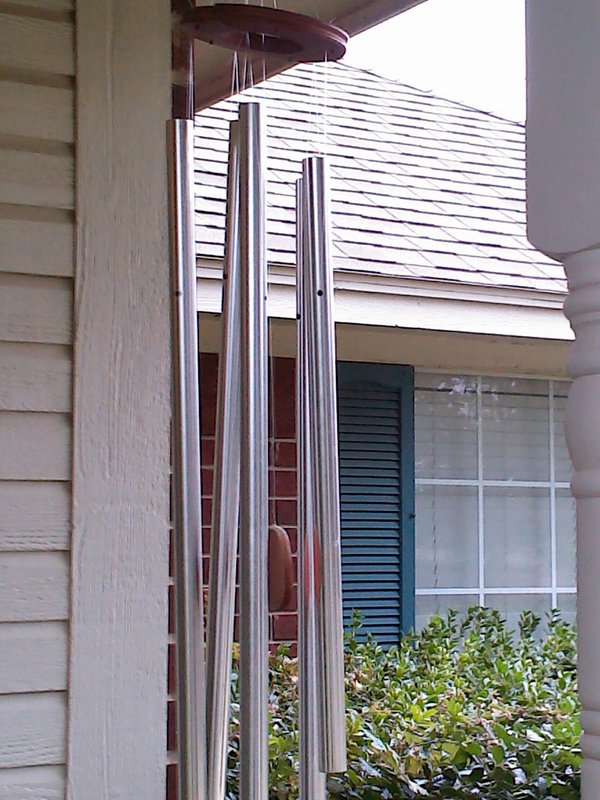
I do not have a stellar history as a green thumb, but I have gotten better in recent years. I guess my mom’s love of plants is finally rubbing off on me! I have a few hanging baskets and some shelf plants that sit on the porch railing, along with a few potted plants on the ground. I also had two windchimes, one of which was my brother’s that he had at his old duplex. After he died, I inherited it, and it made me happy to listen to it tinkling with lovely music.

Unfortunately, the strings that held it together succumbed to the elements, and it fell down. Thankfully, the chimes didn’t break, but I needed to re-string the whole thing, and in order to do that, some of the holes needed to be re-drilled.

I set it aside for a couple of months – until I had time to work on it – and finally I made time this weekend. I sat at the kitchen table with the hand drill and box of assorted bits and went to work. (Yeah, yeah – not the ideal work station, but I managed.) I restrung the chimes with microfilament line (ie, fishing line) and drilled out the clogged string. Ta-da! It isn’t like-new, if you look really closely, but who is going to climb up on a step stool to examine my handiwork? 😉

I hadn’t realized just how much I’ve missed hearing the chime until a breeze started blowing as I hung it back into place. Hearing the sweet music brought a smile to my face. I think Nathan would be proud of me for fixing it … and using power tools, to boot! In the words of Tim the Tool Man, “Arr, arr, arr!” 🙂

What’s Your One Thing? (Prayer Devotional for the week of September 30, 2012)

My former youth minister once posed this question: If your house was on fire and you had time to grab one – and only one – item to take with you, what would you get?  I felt really gypped by that scenario, because while my 20/20-sighted friends began listing sentimental and valuable things like photo albums, pets, jewelry, etc., I knew that the first and only thing I would be able to take with me in that situation would be my glasses. If I didn’t grab those from my bedside, then I might not even make it out of the house, much less with anything in tow!

I was reminded of that question this week, because two of my friends knew either friends or family who lost everything they owned in house fires in recent days. I do not own many things of high monetary value, but I do have some very sentimental things that I would be devastated to lose, like my grandmother’s ring, the porcelain doll that my brother bought for me, the boys’ baby outfits displayed in shadow boxes on the wall and a handmade gift from one of my old students in China. Those things may not all be expensive, but they are irreplaceable.

The apostle Paul knew what it was like to lose – or even give up – valuable things in life. He shared these encouraging words with the church in Corinth: “We are hard pressed on every side, but not crushed; perplexed, but not in despair; persecuted, but not abandoned; struck down, but not destroyed” (2 Corinthians 4:8-9, MSG).

I think what Paul is saying is that sometimes we hold too tightly to the stuff in our lives. That “stuff” may be valuables, but it could also be unhealthy relationships, wayward ambitions or anything else that we have bought/earned/achieved/obtained in our own power. When the world presses in on us and things seem to go up in smoke (literally or figuratively), what are we left with?

If all we have for security is that “stuff,” then we are left with absolutely nothing. But, if the foundation of our lives is Christ, then there is no trial so tough that the enemy can overpower us, because our hope is in Jesus, not ourselves. As Paul suggested to the Corinthians, we need to “… fix our eyes not on what is seen, but on what is unseen, since what is seen is temporary, but what is unseen is eternal” (4:18).