Wednesday Words: Deadlines around the corner

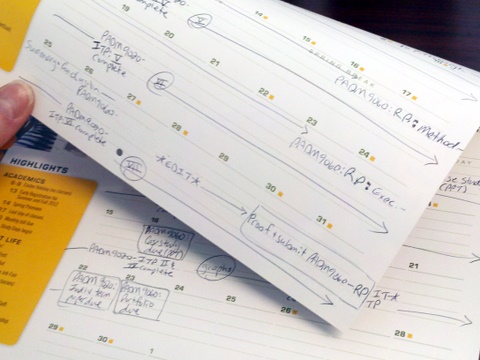
This is what my next couple of months look like, so … farewell, “free” time! 🙂

I am pacing myself on the two individual term papers that I have to write, so I set weekly deadlines to keep me on track with various sections. Plus, it’s a mind trick to tell myself that I “only” have to write five or six pages this week! It breaks down a 20-30 pg paper into reasonable chunks.

I also have a PowerPoint presentation (based on one of the papers) to create, so I’m going to work on it in bits & pieces along the way.

There is also a group term paper for one class, and I am trying to wrangle the team this week so that we can parcel out the sections. I haven’t even added that to the calendar yet, but my part should only be 5-6 pages, so that’s manageable.

The last (and very exciting!) assignment is the draft portfolio that I mentioned last week. It’s a huge undertaking that I spent most of February working on (and I’m almost finished – woohoo!), but now, I have to turn my attention to the lengthy papers.

The good news is that since I will have the portfolio finished soon, then once I complete the term papers, I’ll basically be finished with the semester the last week of April! Yippee! That’ll give me a nice, long break before the summer term begins.

Wednesday Words: Portfolio

In my course on IT and Data Management this semester, we are supposed to work on a draft of what will become our final portfolios for the Doctor of Public Administration program. It is very exciting (and a wee bit nerve-wracking, but mostly exciting) to begin working on it. I can look back on 27 credit hours (9 courses) and see all of the assignments that I have completed thus far, and it makes me feel proud of myself.

As Christians, we are discouraged from being too proud of ourselves, but I think that reflecting on your accomplishments can be a healthy motivational tool to continue on the journey. When I look through my school files and skim over research papers and other assignments that I worked so hard on, I realize that I CAN DO THIS … because I am doing it! 🙂

It reminds me of that scene in Harry Potter and the Prisoner of Azkaban, when Harry realizes that he can cast the Patronus spell because he’d already witnessed himself doing it while he and Hermione were using the time-turner.

Expecto Patronum (video clip)

Now, that is a great feeling.

Monday Musings: Free time

TV? What is that?
Doctoral students don’t have
time to watch TV.

That is partly true, but not entirely. I could watch a little TV, but I can’t watch anything consistently, so rather than be disappointed about missing episodes or having to DVR them for later, I just don’t watch much at all. I catch occasional cooking shows and sporting events, but I’m seasons behind on some of my faves, like The Big Bang Theory, Glee, The Office and NUMB3RS (<<Is that one even still on the air?).

Here’s hoping for something good to watch in, say, the fall of 2014! 😉

Wednesday Words: Distractions

Because every student needs a break from textbooks now & then, I thought that I would share some of my favorite distractions with you today: web comics!

PHD Comics (“Piled Higher & Deeper”) is a hysterically accurate portrayal of life as a graduate student. The university newspaper runs the comic, and it brings me truly laugh-out-loud moments each week.

xkcd is the penultimate comic for geeks. If you never thought math could be funny, then you might be surprised. (I must admit that some of the punchlines are over my journalism-turned-poli-sci-major head, but it’s still one of my faves.)

Bo’s Cafe Life is a tongue-in-cheek look at the lives of a group of friends who are aspiring writers. I’ve had the privilege of conversing with the author a time or two, and he’s a hoot.

Doghouse Diaries puts a spin on relationships, and some of the funniest quips are the comments by the authors/artists below the comic.

Now that you know some of my favorite distractions, I’m going to go skim my RSS feed for the latest! 🙂

Wednesday Words: What not to do as a manager

This week in my Human Resources Management course, we are discussing four management theories. We’re talking about how the various supervisory styles fall into a chart from one of our textbooks by Mainiero. The chart divvies up employee behavior based on whether they perform above or below expectations and whether they get along well with others or not. (The so-called ideal subordinate, then, would be someone who gets along well with others and performs above expectations.)

Here are some of my thoughts on the four theories:

My first job out of college was with a Theory F manager, and it was largely the reason for my decision to leave the field of journalism. I worked as a reporter for a small-town newspaper. After being called out during a staff meeting and verbally abused for submitting photos that he deemed to be sub-par for the upcoming edition, I knew that nothing I did would ever be good enough. I believe that fear is a motivating factor, but it is appropriate in truly do-or-die situations, such as Basic Training for the military. In an office setting, Theory F management is dehumanizing and belittling. Because of that manager, I made a commitment to myself—and I have honored it, all these years since—to never criticize an employee publicly.

I think that Theory X goes hand-in-hand with Theory F, in that being a micro-manager is a mere step or two away from becoming a fear-mongering overlord. Assertive personalities under this type of management could fall into the “talented but abrasive” quadrant of Mainiero’s chart, but they will likely butt heads with the boss. Workers who perform beneath expectations may coddle the boss and tread water in the “charming but unreliable” quadrant, but others will ignore the abrasive boss and fall into the “plateaued but indifferent” quadrant or – like me, in the above example – simply leave the job. I can only imagine that the “ideal subordinate” employee to a Theory F manager would be a Yes Man.

On a related note, I see how Theories Y and Z are closely related. An employee who is properly trained, given reasonable autonomy to do their job (Theory Y) and is treated as part of the “family” because they grasp the mission and vision of the organization (Theory Z) is well suited for productive business. A combination of Theory Y and Z seems to lend itself to a work environment where people build careers, not just hold down jobs.

When does novel become norm?

Some universities are still holding out when it comes to distance education. This Internet thing is still too newfangled for them to grasp. They assert seemingly valid reasons: concerns about mission-creep, emphasis on residential life, cost, etc., but I question the rationale.

I can understand the first point about mission-creep, to an extent, although I believe there are ways to embed the university’s mission within core classes and throughout the curriculum. The second reason primarily applies to undergraduates, but since most graduate students live off-campus, they represent a good cohort with which to begin a distance education program. The third point is the most difficult for me to understand. Software programs such as Blackboard are already in use at many (most?) universities, and using the system for distance learning is no more difficult than using another module of the software; tools like discussion forums and document sharing are already built in! It’s like saying that you can’t create a newsletter because you only use Excel, but you ignore the fact that MS Office Suite also comes with Word and Publisher.

I read an article today about something unfathomable–a tenured professor is walking away from his post at a prestigious university in order to teach solely online. During his recent announcement at a professional conference, the professor explained that “his move was motivated in part by teaching practices that evolved too slowly to be effective.”

Wow. I would like to take back all of the snarky comments that I’ve made over the years about tenured professors becoming lazy, non-caring, out-of-touch fuddy-duddies. (Ok, most of the sassy comments, but a few are still applicable.)

The gist is: since when do you have to be physically present in a classroom to learn? I believe this is especially true at the graduate level. My doctoral classes cover a base of material, but I am expected to expound on what I read/learn and apply the information to my personal research and writing. Even in a “typical” doctoral program, I don’t know of anyone whose professor held them by the hand and guided them through every lecture, every research paper, every project and their dissertation. Graduate students are expected to work independently and become scholars.

I may not be Einstein, but I would gladly hold up the work that I have completed at a distance against a traditional doctoral student’s in-class work. Would my work be better? Perhaps not, but that isn’t the point. It should be comparable. Let a student’s work stand or fall on its own merit, not based on the classroom environment.

Wednesday Words: Catching up

Once again, the holiday weekend threw off my schedule. I totally missed Monday Musings, but I trust that you didn’t lose sleep over it. Last weekend was also Residency Weekend at Valdosta, which I had permission to skip this go-round. (I will go in August, instead, which will be my last official time to have to attend.)

Consequently, I missed a few announcements that some classmates have been gracious enough to try to update me. I am playing catch-up this week and making sure that I understand the assignments that are coming down the pike. So, I don’t have anything current to share, writing wise, but the semester is definitely going full speed ahead!

Wednesday Words: The Art of War

A textbook for one of my classes this semester is The Art of War for Managers, a spin on Sun Tzu’s classic work, The Art of War (which, by the way, is available as a free e-book on Kindle, nook, etc.). The professor for this course is the same one I had last semester, when we discussed Dune as a case study for organizational management. Since it became necessary to familiarize myself with the entire Dune series–beyond just the first book that we were assigned, I thought it would be wise to read the original Art of War text (well, not the original original, because I don’t read Mandarin, but at least the English translation) before the class began.

The book is brief and is a fairly easy read. It is broken down into poetic segments, much like the book of Proverbs in the Bible. Here is one of the statements that resonated with me:

“To see victory only when it is within the ken of the common herd is not the acme of excellence.”

The quote was written in the context of preparing for military battle, but I can see how there are applications toward other aspects of life. Put another way, I think the statement means that we should not define success based on everyone else’s definition. We aren’t cookie-cutter human beings. We have different gifts and skills, and we each have a purpose in life. 🙂

Writing Wednesday: The Golden Rule & the Golden Path

I’m *this* close to being finished with my last term paper of the semester. It has been one of (if not the) most difficult papers I’ve ever written, largely because of my level of comfort/familiarity with the subject matter.

My prof is a big sci-fi fan, which is not a criticism in and of itself, but he also apparently expects his students to be mind-readers and know what he wants, even when he doesn’t specify it in the assignment instructions. It has been very frustrating and is something that I will certainly note in the end-of-semester survey.

I’ve mentioned before (a few times, in fact) that one of our required readings for the semester was Frank Herbert’s 1965 sci-fi classic, Dune. I didn’t loathe the book, but sci-fi isn’t my go-to genre. Furthermore, Dune is a series — and a rather lengthy one, at that — so trying to encapsulate the organizational structure of the society (which is the whole premise of the class) really involves more than just the first book. Much happens in later books (which I have not read, but I will be making a donation to Wikipedia when this class is over) that changes the scope of the storyline.

So, given a list of topics from which to choose, I set out to write about “universal political truths” in Dune. Easy enough, right? Um, sure, except for the fact that no one agrees on anything universal when it comes to politics. I decided to look at the Golden Rule, because it transcends numerous cultural, religious and political boundaries and could, arguably, be described as “universal.” In fact, one article I found said that at least 10 world religions have some variation of the Golden Rule in their texts.

I looked at the standard rendition (Do unto others as you would have them do unto you), the negative interpretation (Don’t do unto others as you wouldn’t want them to do unto you) and the economic version (He who has the gold, rules), with examples of how each rule is demonstrated in Dune. Then, I listed a fourth variation that I linked to the Dune saga beyond the first book: Do unto others so that they will not do unto themselves. This final scenario has to do with Leto II’s tyrannical but messianic rule that he set into motion in order to save humankind, aka, the Golden Path.

Since this blasted paper had to be 20-30 pages (rather than the typical 12), I had to write about more than just variations of the Golden Rule, so I pulled in some philosophy by Immanuel Kant and John Rawls, both of whom fall under the category of “social contract” philosophers, which I tied in with the Golden Rule and compared to Leto II. I’m neither a Kant nor Rawls scholar, so I’ve been grasping at straws trying to wrap my head around their perspectives well enough to write coherently about them.

It’s a twisted, convoluted effort, but I think I’ve made it work. I’m still about three pages shy of being finished, but the boys have kids’ church tonight, so I hope to finish TODAY. Then, I can study for my other class’ final exam that begins later this week!
Real-life heroes

I was busy the past couple of evenings trying to make sense of the future of nanotechnology and didn’t have a chance to tell you about meeting one of my real-life heroes on Wednesday night …

Condoleezza Rice speaks at Baylor University

Yes, that is Dr. Condoleezza Rice, former Secretary of State and one of my biggest role models! And, I got to shake her hand!! 🙂

She shared candidly about her growing-up years, challenges she faced in segregated Alabama, waffling about what to study in college and her experiences in Washington, D.C. (The video can be found here.) I appreciated her insights as a professional woman who went against the grain. She pulled no punches in saying that there are times in life when you have to be twice as good just for others to see you as good enough. She balanced that with a reminder that succumbing to victimhood is a losing battle and to not lose sight of your abilities and dreams.

She faced numerous obstacles as a woman of color in a white man’s field, and although our back-stories are different in many ways, I related to much of what she shared because of my own goals that don’t seem to mesh, at first glance, with the life of a woman raising five kids. She inspires me.

P.S. The nanotechnology thing was my portion of a group paper and has little to do with my scholarly interests, on the whole. I did, however, find it pretty interesting. One term paper and one group assignment down; one more term paper to go! I am hoping to finish it by Thanksgiving.