Only One King (Prayer Devotional for the week of January 24, 2016)

I am teaching two sections of American National Government this semester, and I love it. Some people don’t like teaching freshmen because they are, well, freshmen. I think it’s awesome. I love those light bulb moments when they realize that my class isn’t going to be a complete snorefest like they expected. Anyway, we were talking last week about different forms of government and how the colonists were trying to escape what they viewed as an oppressive government. Although our Founding Fathers disagreed on a lot of things, one thing they rallied behind was NO KING. They did not want to create another monarchy.


I thought about that particular class when I came across a passage in Matthew 27. Verses 32-44 detail Jesus’ crucifixion. The soldiers, religious leaders, and even the general public seemed to be hung up on the notion of Jesus as King of the Jews, or King of Israel, as some translations state. They hung a sign of mockery above his head reading, “This is Jesus, the King of the Jews.” (v. 37). The religious leaders taunted him, saying that if he’s the King of the Jews, then he should save himself (v. 41-43).


Here’s the catch: whether we’re talking about a political science class or trying to make a spiritual application, there can only be ONE king. In a monarchy, there may be a ruling family who passes down the crown from generation to generation, but at any given time, there is one king or queen in charge. Trying to have two people wear the crown is a recipe for disaster.


The same concept holds true in our spiritual lives. Matthew 6:24 and Luke 16:13 remind us that we cannot serve both God and money. We have to choose one over the other – either God or our worldly desires.


Jesus did not come to serve as a political leader. Instead, he challenged our traditional ideas of rulership by introducing us to a personal relationship with the Lord. We don’t need a political king to sweep in and take over; we need a spiritual Lord to whom we willingly submit our lives. He is fully capable of leading and guiding us, but only if we allow him that position in our hearts. He does not demand our loyalty. We retain the free will to choose the world over him, if that’s what we really want.


However, I implore you to give him authority over your life, and I feel confident in saying that you will not regret it. Walking in a relationship with Christ is more spectacular than all the ticker tape parades and inauguration parties in the whole, entire world.

March Madness: Supreme Court Version

I really should get some sleep, but I have to jot down some thoughts about class tonight first. This was one of the most fulfilling days that I have experienced as a college instructor, thus far. The chapter that we covered is probably the driest material in the entire textbook: the judicial system. There are several Latin terms, a lot of procedural dos and don’ts, and it is difficult to make it sound interesting. It is important; don’t get me wrong … just not particularly riveting.

I took my lecture notes with me to lunch earlier today, to spend some more time prepping before the 6pm class. As I was looking back over a few sections, this picture began to piece together in my head. I thought it might be corny, but it was worth a shot!

Here’s what I drew on the whiteboard when I got to the classroom:

The players in the judiciary

The players in the judiciary

Using the March Madness basketball theme, I sketched a basketball court for the University of Common Law whose motto is “stare decisis.” The “C” in center court stands for Constitution. The referee has “jurisdiction,” while the two coaches are yelling, “Justiciable controversy!” and “Standing to sue!” to have their issues heard.

The player with the ball is “activist,” because he’s on the offense, and the player who is just standing there is “restraintist.” The two baskets represent types of precedent that the judiciary weighs when making decisions: case law and statutes.

The cheerleaders represent interest groups on the side of the court. The Supreme Court justices are on the right (there are 9), and four of them are circled, since that’s how many have to agree to hear a case. The Senate is in the lower right corner, keeping an eye on the court and saying, “Bork” because they might not want to confirm one of the judges.

Appellate Courts Bracket

Appellate Courts Bracket

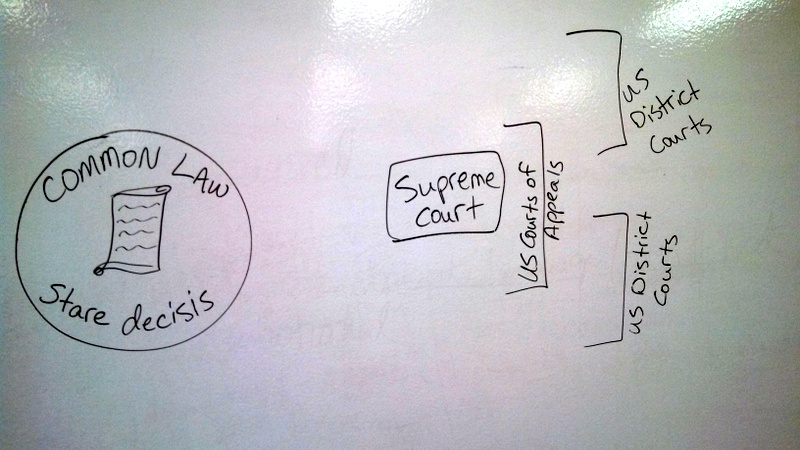
On the far right, next to the Common Law seal (with a scroll to symbolize the Constitution), I put sample brackets to represent the U.S. District Courts (there are 94), U.S. Circuit Courts of Appeals (only 13 of these), and finally the end of the line: the Supreme Court.

I really liked being able to reference the board instead of just the PowerPoint slides as we went through the material, and I think it helped to put some of the concepts into practical (albeit silly) terms.

I was pleased enough that the lesson went over better than I had hoped, but that isn’t even the best part of the class. One of the students who is doing really well in the class came up to me at the end and asked for my advice about possibly switching his major to political science. Wow! I know it isn’t just because of my awesome teaching (lol), but I’d like to think that I had a little bit of influence toward his interest in the subject! 🙂  It made my day.